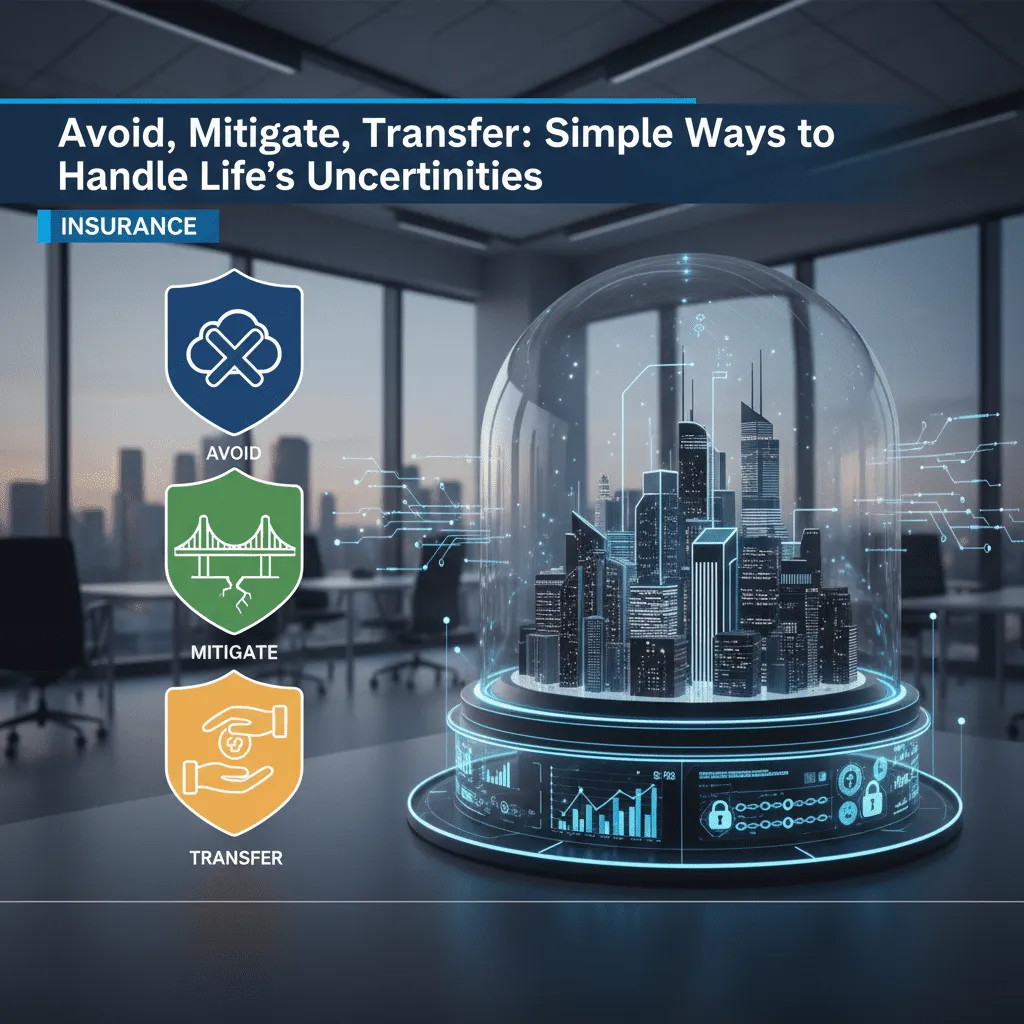
Avoid, Mitigate, Transfer: Simple Ways to Handle Life’s Uncertainties
Avoid, Mitigate, Transfer: A Simple Framework to Master Life’s Uncertainties
Life doesn’t come with a manual, but it almost certainly comes with risks. Whether it’s a sudden transmission failure in your car, a diagnosis that stops you in your tracks, or a corporate restructuring that leaves your career in limbo, uncertainty is perhaps the only guarantee we have.
But what if you could manage your life like a Fortune 500 CEO manages a conglomerate?
In my years working with both corporate risk frameworks and personal financial planning, I’ve noticed a glaring gap. Large companies spend millions developing “Enterprise Risk Management” protocols to survive market volatility. Meanwhile, most individuals just cross their fingers and hope for the best. We tend to be reactive rather than proactive. We wait for the pipe to burst before we learn where the main water valve is.
This article bridges that gap. We are going to take the gold-standard Risk Management Strategies in Personal Life—Avoid, Mitigate, Transfer, and Accept—and translate them from corporate-speak into a practical survival guide for your finances, health, and sanity.

The 4 Pillars of Personal Risk Management
Before we dive into the specific tactics, we need to understand the framework. In professional project management (like the PMP methodology) or ISO 31000 standards, risk isn’t just “bad stuff.” It’s defined by two variables: Probability (how likely is it to happen?) and Impact (how bad will it hurt if it does?).
Once you understand those two variables, you have four distinct ways to respond. Let’s break them down.
1. Avoidance: Eliminating the Threat
Risk avoidance is the nuclear option. It implies zero tolerance. When you choose to avoid a risk, you are changing your plan or behavior to ensure the risk cannot occur. You aren’t reducing the chance; you are removing the possibility entirely.
In my opinion, people often confuse “avoidance” with “ignoring.” Ignoring a risk (like not opening a medical bill) actually increases it. True avoidance requires action.
Real-Life Examples:
- Digital Risk: You delete a social media account entirely to prevent data harvesting. You aren’t just adjusting privacy settings (mitigation); you are removing the platform.
- Financial Risk: You refuse to invest in speculative crypto assets. By not participating in the market, you avoid the volatility completely.
- Safety Risk: A designated driver. By handing over the keys, you avoid the risk of a DUI or an alcohol-related accident 100%.
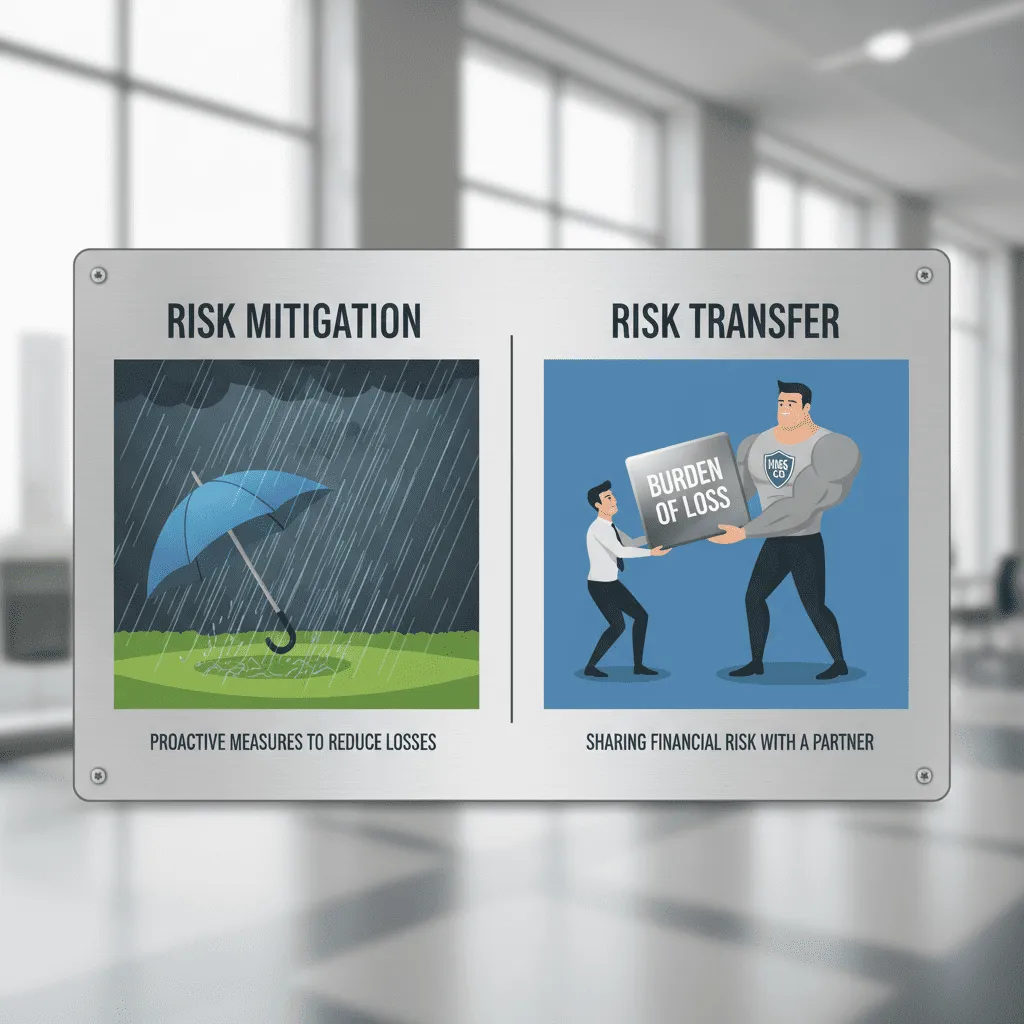
2. Mitigation: Reducing the Impact
This is where we live most of our lives. You can’t avoid everything—you have to drive to work, you have to eat, you have to invest to beat inflation. Mitigation involves taking steps to reduce the probability of a risk happening or reducing the impact if it does happen.
Think of this as the “cushion” strategy. You know you might fall, so you put a mattress on the floor.
Real-Life Examples:
- Health: You exercise and eat a balanced diet. This doesn’t guarantee you won’t get sick (avoidance is impossible here), but it mitigates the severity of illness and speeds up recovery.
- Data: Regularly backing up your hard drive. You can’t stop a hard drive from failing eventually, but you can mitigate the disaster by ensuring you don’t lose your data.
Financial mitigation is critical. According to the Federal Reserve Board’s report on Economic Well-Being of U.S. Households in 2023, 63% of U.S. adults said they would cover a hypothetical $400 emergency expense using cash. This implies a significant mitigation gap, as 37% of the population would have to borrow or sell something to handle a minor crisis.
3. Transfer: Sharing the Burden
Risk transfer doesn’t eliminate the risk; it shifts the responsibility (usually the financial cost) to a third party. This is the foundation of the insurance industry. You pay a small, known cost (premium) to avoid a potentially catastrophic, unknown cost (a lawsuit, a house fire, a premature death).
In my experience, this is the area where people make the most dangerous errors. We often assume “it won’t happen to me,” or we view insurance premiums as wasted money rather than the price of stability.
Real-Life Examples:
- Warranties: Buying an extended warranty on a laptop transfers the risk of mechanical failure to the manufacturer.
- Outsourcing: Hiring a certified electrician instead of doing DIY wiring transfers the liability of electrical fires (and code violations) to the professional.
4. Acceptance: The Psychology of Peace
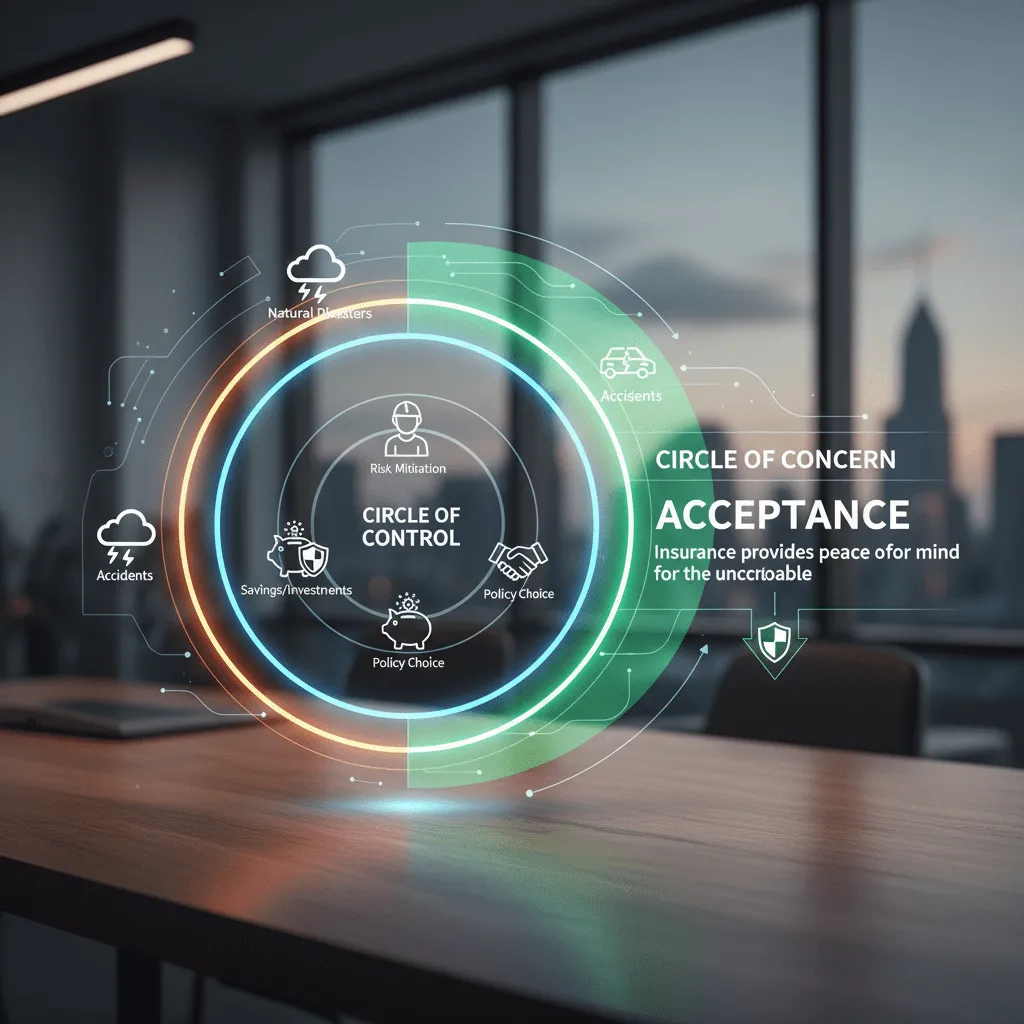
Finally, we have acceptance. This is acknowledging that a risk exists, and deciding that the cost of mitigating or avoiding it is too high compared to the probability. It is a conscious choice to say, “If this happens, I will deal with it.”
This is not passivity; it is Stoicism. It is the “Serenity Prayer” in risk management form. You accept the risk of rain on your wedding day because you can’t control the weather, and moving the date is too expensive.
Applying the Framework to Your Finances
Financial uncertainty is usually the biggest stressor in modern life. Let’s look at how to apply these strategies specifically to your money. This isn’t just theory; the data shows we are facing a crisis of preparedness.
The Mitigation Imperative: Emergency Funds
The most powerful mitigation tool in your financial arsenal is the emergency fund. It turns a “financial disaster” into a “minor inconvenience.”
As I mentioned earlier, the Federal Reserve data indicates that over a third of Americans struggle with a $400 expense. But real life hits harder than $400. A transmission repair is $3,000. A deductible is $1,000. A job loss can cost tens of thousands.
To properly mitigate this, you need liquidity. The general rule of thumb is 3 to 6 months of living expenses. This buffer reduces the impact of income loss. Without it, you are forced to accept high-interest debt, which compounds the risk.
The Transfer Gap: Life Insurance
If you have dependents, living without life insurance is a massive, unmanaged risk. You are essentially “accepting” the risk that your family will fall into poverty if you die. That is an unacceptable acceptance strategy.
However, there is a disconnect between need and action. According to the LIMRA 2024 Insurance Barometer Study, 42% of Americans—representing 102 million adults—say they need life insurance or need more coverage than they currently have.
Why this gap? Often, it’s a lack of information. The same 2024 LIMRA study found that 72% of consumers overestimate the true cost of life insurance. People are avoiding a solution because they perceive the price (the transfer cost) to be higher than it actually is. In reality, term life insurance is often cheaper than a monthly streaming subscription.
Managing Health and Safety Risks
Health is wealth, as the cliché goes, but it’s also the area where we feel the most vulnerable. While we often worry about rare diseases or random violence, the statistics show that the biggest risks are often mundane—and manageable.
Avoidance and Mitigation in Daily Life
We often think of “accidents” as unavoidable fate. However, data suggests otherwise. According to Injury Facts 2024 from the National Safety Council, preventable injury is the 4th leading cause of death in the US. The report notes that an American is accidentally injured every second.
How do we apply our framework here?
- Avoid: High-risk behaviors. Texting while driving isn’t a “risk” you mitigate; it’s a risk you avoid.
- Mitigate: Preventative screenings. Catching a health issue early mitigates the impact. It turns a life-threatening condition into a manageable one.
The Mental Health Aspect: Acceptance
We are living in a time of high anxiety. According to the American Psychological Association’s Stress in America 2024 report, 77% of adults reported the future of the nation as a significant source of stress, and 73% cited the economy.
This is where Acceptance becomes a mental health tool. You cannot mitigate the national economy. You cannot avoid political turmoil entirely. Attempting to control these macro-events leads to burnout. The healthiest risk response here is acceptance of the macro, focusing your energy on the micro (your household budget, your local community)—the things you can control.
Digital & Career Uncertainty: The Modern Frontier
Twenty years ago, “cyber risk” wasn’t on a personal risk matrix. Today, it’s paramount. The digital landscape has introduced threats that require sophisticated transfer and mitigation strategies.
The Cyber Reality
You might think cyber attacks only target big banks, but you are a target. According to the Allianz Risk Barometer 2024, cyber incidents (ransomware, data breaches) rank as the most important global risk for 2024, garnering 36% of responses from risk management experts.
Applying the Framework:
- Transfer: Consider identity theft protection services or cyber insurance riders on your homeowner’s policy.
- Mitigate: Use a password manager and enable Two-Factor Authentication (2FA) everywhere. This reduces the probability of a breach significantly.
The Natural Catastrophe Gap
Climate uncertainty is also impacting our homes and assets. There is a worrying trend where people assume they are covered when they aren’t. According to the Swiss Re Institute Sigma Report 1/2024, in 2023, the global protection gap for natural catastrophes was a staggering $385 billion. This means 62% of global economic losses were uninsured.
This is a failed Transfer strategy. If you live in a flood zone but don’t have flood insurance (which is usually separate from homeowners insurance), you have inadvertently chosen to Accept the risk of total loss. Make sure that acceptance is intentional, not accidental.
When to Use Which Strategy? (The Decision Matrix)
So, how do you decide whether to avoid, mitigate, transfer, or accept? It all comes down to the Personal Risk Matrix. This is the visual tool I use with clients to categorize their worries.

| Scenario | Impact | Probability | Recommended Strategy |
|---|---|---|---|
| Drunk Driving / Smoking | High (Death/Jail) | High | AVOID – Stop the behavior immediately. |
| House Fire / Premature Death | High (Catastrophic) | Low | TRANSFER – Buy Insurance. You can’t afford the hit, but it’s rare. |
| Minor Car Repair / Common Cold | Low (Manageable) | High | MITIGATE – Emergency fund & Healthy habits. |
| Losing a Pen / Sudden Rain | Low | Low | ACCEPT – Don’t sweat it. Live your life. |
In my opinion, the most critical quadrant is High Impact / Low Probability. This is the “Black Swan” territory. Because the probability is low, our human brains trick us into thinking we don’t need to worry about it. This is why people skip life insurance or flood insurance. But because the impact is catastrophic, Transfer is the only logical move.
FAQ: Common Questions on Personal Risk
The four main risk response strategies are Avoid (eliminate the cause completely), Mitigate (reduce the likelihood or impact), Transfer (assign the financial burden to a third party like an insurance company), and Accept (acknowledge the risk and prepare to deal with the consequences if they occur).
A classic example is regular exercise and savings. Exercise doesn’t guarantee you won’t get sick (avoidance), but it ensures your body recovers faster if you do. Similarly, an emergency fund doesn’t stop your car from breaking down, but it mitigates the financial devastation when it happens.
Buying insurance is Risk Transfer. You are not stopping the accident from happening (which would be avoidance); rather, you are transferring the financial cost of that accident to the insurance company in exchange for a premium.
You should accept a risk when the Impact is Low and the Cost of Mitigation is High. For example, buying insurance for a $10 toy is unnecessary; you accept the risk it might break. You should also accept risks that are outside your control, such as macroeconomic shifts, to preserve mental health.
Avoiding risk means changing your plan to make the probability 0% (e.g., not investing in the stock market to avoid loss). Reducing (Mitigating) risk means taking steps to lower the impact while still participating (e.g., investing in a diversified ETF portfolio to lower volatility while still seeking growth).
Conclusion: From Anxiety to Authority
The goal of personal risk management isn’t to create a boring, sheltered life. It’s actually the opposite. By effectively managing the downsides, you give yourself the confidence to take the upsides. You can start that business because you have an emergency fund (Mitigation). You can go on that adventure trip because you have health insurance (Transfer).
We often walk through life feeling like passengers in a car driven by fate. But when you apply this framework—Avoid, Mitigate, Transfer, Accept—you climb into the driver’s seat. You stop worrying about the things you’ve accepted, and you stop ignoring the things you should transfer.
Start small. Look at your life this week. Identify one risk you’ve been ignoring. Is it a strange noise in your car? A lack of life insurance? A password you haven’t changed in five years? Apply the matrix. Make a decision. Peace of mind is waiting on the other side of that choice.