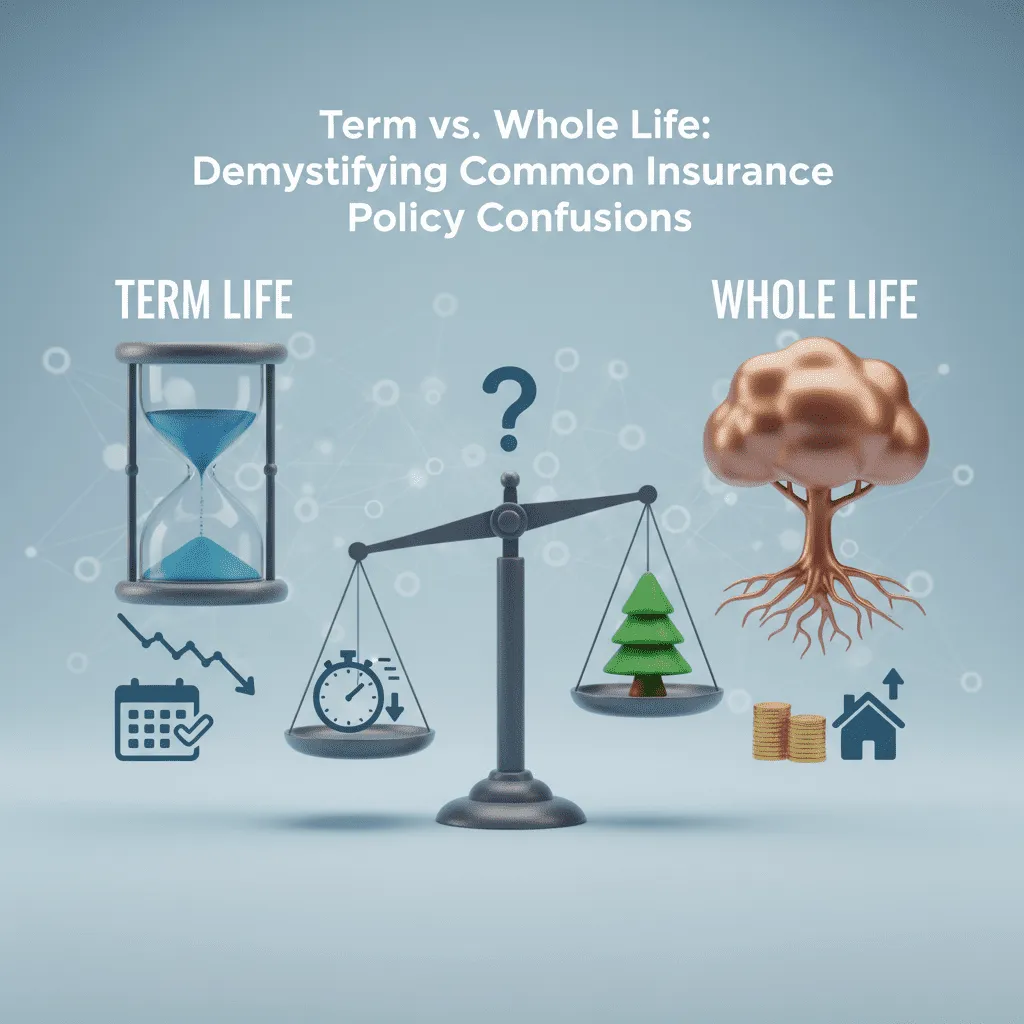
emystifying Common Insurance Policy Confusions
Term vs. Whole Life Insurance: The 2025 Decision Guide & Cost Comparison
Did you know that nearly 40% of whole life insurance policies lapse within the first 10 years? That is not just a statistic; it represents billions of dollars in lost premiums and shattered financial plans.
In my years analyzing the insurance market, the most heartbreaking stories aren’t about people who didn’t have insurance—they are about people who bought the wrong kind, couldn’t afford the premiums when life got tough, and walked away with nothing. According to a 2021 study by the Society of Actuaries, approximately 25% of life insurance policies are terminated or lapsed within the first three years alone.
The debate between Term vs. Whole Life Insurance is fierce. On one side, you have financial gurus like Dave Ramsey shouting “buy term and invest the difference.” On the other, insurance agents promise “tax-free wealth” and “being your own banker.”
Who is telling the truth? As it turns out, the math doesn’t lie.
We are going to dismantle the marketing fluff. Using 2024-2025 data from industry authorities like LIMRA and the NAIC, we will break down the true costs, the hidden risks of cash value, and the specific “2% rule” of who actually needs permanent coverage.
What We Will Cover:
The Core Difference: Renting vs. Owning Your Coverage
To make a smart financial decision, you first need to strip away the jargon. Think of life insurance in terms of housing.
How Term Life Works (The “Lease” Model)
Term life insurance is like renting an apartment. You agree to pay a monthly premium for a set period—usually 10, 20, or 30 years. If you die during that “lease,” the insurance company pays your beneficiaries. If you outlive the term, the contract ends, and you walk away with nothing.
It sounds like a raw deal to walk away with nothing, right? But consider this: because there is no investment account attached, it is incredibly cheap. According to LIMRA’s 2024 Insurance Barometer Study, more than half of Americans overestimate the cost of life insurance by three times. They expect it to be expensive, so they don’t buy it.
How Whole Life Works (The “Homeownership” Model)
Whole life insurance (a type of permanent life insurance) is like buying a home with a mortgage. As long as you pay your premiums, you are covered forever—until age 100 or even 121.
Part of your premium goes toward the cost of insurance (the death benefit), and another part goes into a “cash value” account. This account grows over time, guaranteed. It feels like forced savings. But just like homeownership, it comes with high maintenance costs (fees) and a massive down payment (premiums).
The “Convertibility” Feature: The Bridge Between Both
Here is a secret many agents gloss over: most quality Term policies are convertible. This means you can swap your Term policy for a Whole Life policy later—without a medical exam.
I often tell young parents: “If you can’t afford the ‘house’ (Whole Life) yet, rent the ‘apartment’ (Term) with an option to buy later.” This secures your insurability even if you develop a health condition like diabetes or cancer down the road.
The Price of Protection: 2025 Cost Comparison Analysis
Let’s get to the numbers. The primary reason people choose Term is simple economics. Whole life insurance rates can be 5 to 15 times higher than term life insurance for the same death benefit amount, according to a 2024 analysis by Forbes Advisor.
Below is a comparison of average monthly rates for a $500,000 policy for a male in excellent health.
| Age | 20-Year Term Premium | Whole Life Premium | Annual Cost Difference |
|---|---|---|---|
| 30 | $26/mo | $410/mo | $4,608 |
| 40 | $42/mo | $680/mo | $7,656 |
| 50 | $112/mo | $1,240/mo | $13,536 |

Why Whole Life Costs So Much More
It’s not just price gouging; the mechanics are different. With Term life, the insurance company is betting you won’t die within the 20 years. Statistically, they usually win. With Whole life, the company knows they will have to pay the death benefit eventually (assuming you keep the policy). Therefore, they must collect significantly more money upfront to invest and build the payout reserves.
The “Cash Value” Component Demystified
Proponents of Whole Life argue that Term is a waste because you don’t get anything back. They point to “Cash Value” as the solution. But what is it, really?
Guaranteed vs. Non-Guaranteed Returns
Your policy will have a guaranteed growth rate (often around 2-3%) and a non-guaranteed dividend. While major mutual insurers announced 2024 dividend interest rates averaging between 5.0% and 6.0%, it is crucial to understand that this is not a yield on your money like a savings account.
Tony Steuer, CLU, LA, a leading financial literacy advocate, puts it clearly in his educational resources: “Life insurance is for protection, not investment. Mixing the two usually results in paying high fees for poor returns.”
Dividends Explained: It’s Not Interest, It’s a Refund
Legally, life insurance dividends are considered a “return of excess premium.” This is why they are generally tax-free—the IRS views them as the company paying you back because they overcharged you initially. While they can add up over 40 years, relying on them for wealth accumulation is inefficient compared to market investments.
The Truth About “Borrowing Your Own Money”
Agents love the “Infinite Banking” concept—borrowing against your policy cash value. Here is the catch: You are paying interest to borrow your own equity. While the loan rates (often 5-8% in 2024) might be lower than a credit card, if you die with an outstanding loan, that amount is subtracted from the death benefit your family receives.
“Buy Term and Invest the Difference”: Does the Math Hold Up?
The strategy championed by financial experts is “Buy Term and Invest the Difference” (BTID). Let’s run a real-world scenario to see if it holds water.
Case Study: The 30-Year Wealth Race
Scenario: Meet Michael, a 30-year-old non-smoker. He has a budget of $450/month for insurance/savings.
- Option A (Whole Life): He buys a $500,000 Whole Life policy. Premium: $450/mo.
- Option B (BTID): He buys a $500,000 Term policy for $25/mo. He invests the remaining $425/mo in a diversified S&P 500 ETF.
The Results at Age 60 (30 Years Later):
- Whole Life Cash Value: Projected roughly $280,000 – $320,000 (based on current dividend scales).
- Investment Account (BTID): Assuming a conservative 7% annual return (inflation-adjusted), his investment account is worth approximately $506,000.
Furthermore, if Michael dies at age 60:
- With Whole Life: His family gets the $500,000 death benefit. (The insurance company typically keeps the cash value).
- With BTID: His family gets the Term payout (if still active) OR they simply inherit the $506,000 investment account.

The “Behavioral Gap” Risk
There is one major flaw in the BTID strategy: Human behavior.
Will you actually invest that $425 every single month? Or will you spend it on pizza, new shoes, or a car payment? Whole Life acts as a “forced savings” mechanism. If you lack financial discipline, the lower return of Whole Life is still better than the zero return of not saving at all.
Critical Risks & Hidden Clauses
Before you sign any contract, you must understand the risks. The biggest risk isn’t dying—it’s quitting.
Surrender Charges and the “Breakeven Year”
According to Michael Kitces, MSFS, CFP, “The internal rate of return on whole life insurance is often negative for the first 5-10 years due to front-loaded commissions and administrative costs.”
If you buy a Whole Life policy today and cancel it in 3 years, you will likely get back $0. The agent’s commission and administrative fees eat up almost all your early premiums. You usually don’t break even (cash value = premiums paid) until year 12 or 15.
Lapse Rates: The Silent Wealth Killer
Remember that statistic from the start? Nearly 25% of policies lapse within 3 years. When a policy lapses, you lose the coverage and the money you put in. This is why buying a policy you can barely afford is dangerous.
According to a report from Swiss Re Institute, the coverage gap in the US is over $12 trillion. High-cost policies that people cancel contribute to this gap, leaving families vulnerable exactly when they need protection most.
Who Actually Needs Whole Life? (The 2% Rule)
I am not saying Whole Life is a scam. It is a highly specialized tool. Based on standard financial planning principles, Whole Life is generally superior only for about 2% of the population.
You Should Consider Whole Life If:
- You have a lifelong dependent: If you have a child with special needs who will require financial care even after you die at age 85, Term insurance won’t work (it expires). You need permanent coverage.
- You have a massive estate: If your net worth exceeds the federal estate tax exemption (over $13 million in 2024), you need liquid cash to pay estate taxes so your heirs don’t have to sell the family business.
- You have maxed out everything else: If you have maxed your 401(k), IRA, and HSA, and you still have high cash flow and want a tax-advantaged bond-like asset.
For everyone else—young families, mortgage holders, income earners—Term Life is the recommendation of Consumer Reports and almost every fee-only financial planner.
FAQ: Your Burning Questions Answered
Which is better, term or whole life insurance?
For 98% of people, Term life is better. It provides the maximum coverage for the lowest cost during the years you need it most (when raising kids or paying a mortgage). Whole life is better for high-net-worth estate planning.
Do you get money back at the end of term life insurance?
Generally, no. It is like car insurance; you don’t get a refund if you don’t crash. However, there is a “Return of Premium” (ROP) rider available, but it often doubles or triples the cost, making it less efficient than investing the difference.
Why is whole life insurance so expensive?
It is expensive because it bundles insurance with an investment account, and it guarantees a payout eventually (assuming you pay premiums). You are pre-paying for your death benefit at age 90 or 100.
Is whole life insurance tax-free?
The death benefit is generally income-tax-free for beneficiaries. The cash value grows tax-deferred. You can withdraw up to your “basis” (amount paid in) tax-free, but gains are taxed unless borrowed against the policy.
What happens if I stop paying my whole life premium?
If you have cash value, the insurer may use it to pay the premiums until the money runs out. If there is no cash value, the policy lapses, and you lose coverage.
Final Decision Matrix
Choose Term Life If: You want affordable protection, have debt/mortgage, need to replace income for 10-30 years, and feel comfortable investing your own savings.
Choose Whole Life If: You need coverage for your entire life (estate tax/special needs child), possess a high net worth, and have already maximized all other tax-advantaged investment accounts.
Ultimately, the best life insurance policy is the one that is in force on the day you die. For most people, affordability is the key to keeping that policy active. Don’t let the allure of “cash value” distract you from the primary goal: protecting the people you love.