How to Navigate the Insurance Claim Process
Talking to Your Adjuster: How to Navigate the Insurance Claim Process (Scripts & Strategy)
Article Roadmap
The insurance adjuster is not your friend, but they don’t have to be your enemy. They are a professional protecting a bottom line. In the chaotic moments following a car accident or home disaster, it is natural to want to vent, explain, and seek comfort. But when you are on the phone with an insurance carrier, you are stepping into a business negotiation, not a therapy session.
The Reality of 2024-2025 Claims: You have every right to be cautious. According to Weiss Ratings, in 2024, five major property insurers closed nearly 50% of homeowner claims with no payment whatsoever. This highlights the extreme difficulty of the current claims environment.
I have spent years analyzing the insurance industry, and the biggest mistake I see policyholders make is assuming the system will work automatically in their favor. It won’t. You need a strategy. This guide covers how to talk to an insurance claims adjuster using proven scripts, psychological tactics, and data-backed negotiation methods.
Understanding the Adjuster’s Role (and Workload)
Before you pick up the phone, you need to understand the human on the other side. Competitors often paint adjusters as robotic villains. The reality is often more mundane: they are overworked, stressed employees managing a massive caseload.
Most staff adjusters are handling between 50 to 100 open claims simultaneously. They are driven by “cycle times”—how fast they can close a file. Your goal is to position yourself as the “easy file to settle fairly,” not the “easy file to deny.”
Know Who You Are Talking To
- Staff Adjuster: Employed directly by the insurance company. They have limited authority and strict guidelines.
- Independent Adjuster (IA): A contractor hired during high-volume periods (like hurricanes). They submit reports to the insurer for approval. They have no authority to cut checks.
- Public Adjuster (PA): An independent professional you hire to represent you. They take a percentage of the settlement.
Phase 1: Preparation Before the First Ring
If you call your insurer immediately after an accident while your adrenaline is spiking, you are likely to say something that can devalue your claim. Unless it is a medical emergency, take a breath.
The “Claim Journal” Rule
Memory is fallible; documentation is evidence. Start a dedicated notebook or digital document. For every interaction, record:
- Date and Time
- Name of the person you spoke with (and their ID number)
- Key points discussed
- Deadlines they promised
Review Your Policy (The Declarations Page)
Do not let the adjuster tell you what your coverage is. Pull out your “Declarations Page.” You need to know your deductibles and limits for bodily injury, property damage, and loss of use. If you don’t know your limits, you are negotiating in the dark.
Phase 2: The First Conversation (Scripting & Tactics)
This is where most errors occur. The adjuster’s goal in the first call is to gather facts and set reserves (the amount of money they set aside to pay your claim). They are also listening for insurance policy exclusions or admissions of fault.
What NOT to Say (The Red Flags)
Certain phrases act as “trigger words” that can flag a file for fraud investigation or denial. Here is a breakdown of what to avoid:
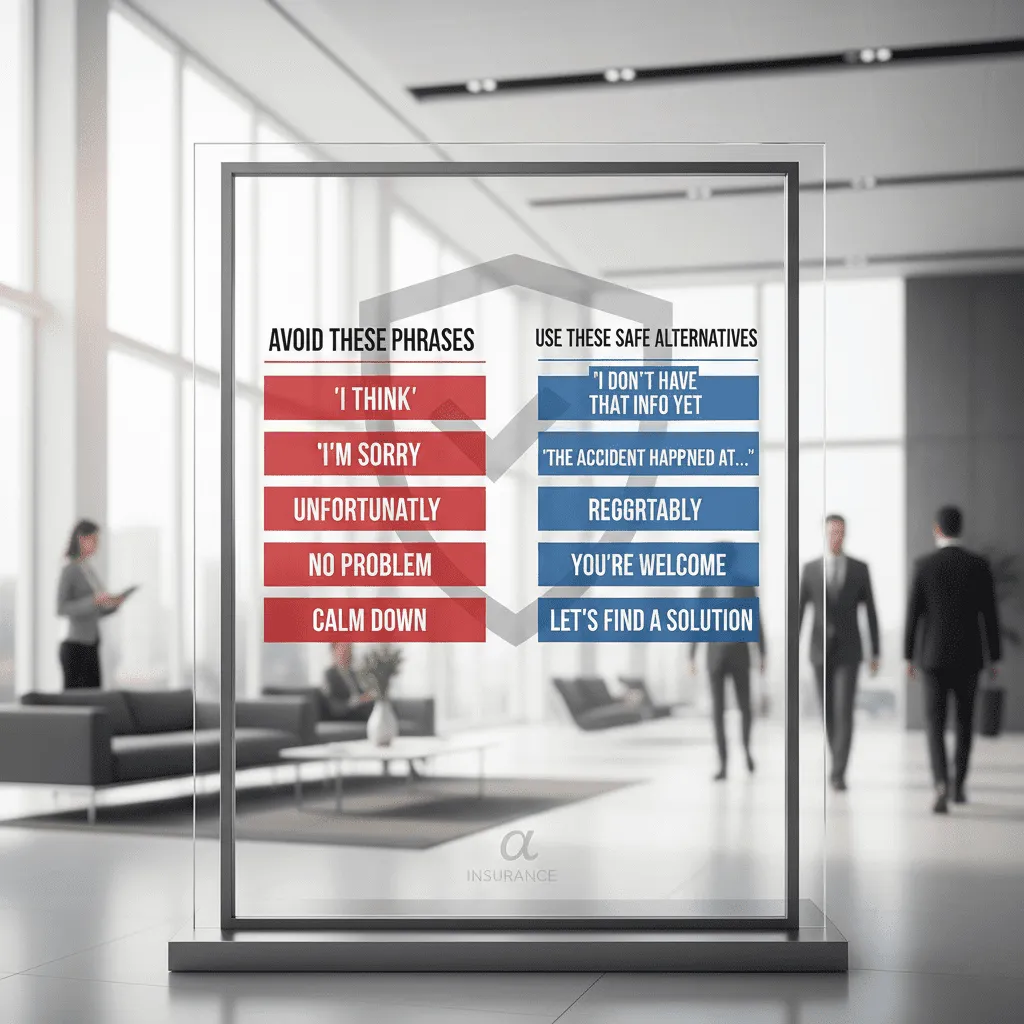
| Instead of Saying… | Say This… | Why? |
|---|---|---|
| “I’m sorry” or “I apologize” | “The accident occurred at [Location]…” | “Sorry” can be legally interpreted as an admission of liability (fault). |
| “I’m fine” | “I am currently seeing a doctor to assess my condition.” | Injuries like whiplash often take days to appear. |
| “I think the light was green…” | “I do not want to guess. I will refer to the police report.” | Guessing creates inconsistencies. Stick to verified facts. |
| “My neck hurts a little.” | “I have sustained an injury to my neck.” | Minimizing your own pain reduces the settlement value (“pain and suffering multiplier”). |
Handling the Recorded Statement
One of the most common claims adjuster tricks to avoid is the pressure to give a recorded statement immediately.
The Tactical Reality: If you are speaking to the other driver’s insurance company, you are generally not legally required to give a recorded statement. If you are speaking to your own insurer, your policy likely requires cooperation, but you can negotiate when and how that happens.
“I fully intend to cooperate with the investigation. However, I am not comfortable providing a recorded statement at this moment. I am happy to provide a written statement of the facts once I have composed them, or I can answer specific questions via email so there is a clear record for both of us.”
This approach prevents you from being manipulated into a corner by a skilled interrogator while you are still shaken up.
Phase 3: The Inspection and Valuation
Once liability is addressed, the focus shifts to valuation. Whether it’s a smashed bumper or a storm-damaged roof, this is where the money is determined.
Navigating Property Claims
When the adjuster comes to inspect your property (home or auto), do not let them work alone. Walk with them. Point out the damage. If you let them inspect alone, they may miss subtle damage that you are aware of.
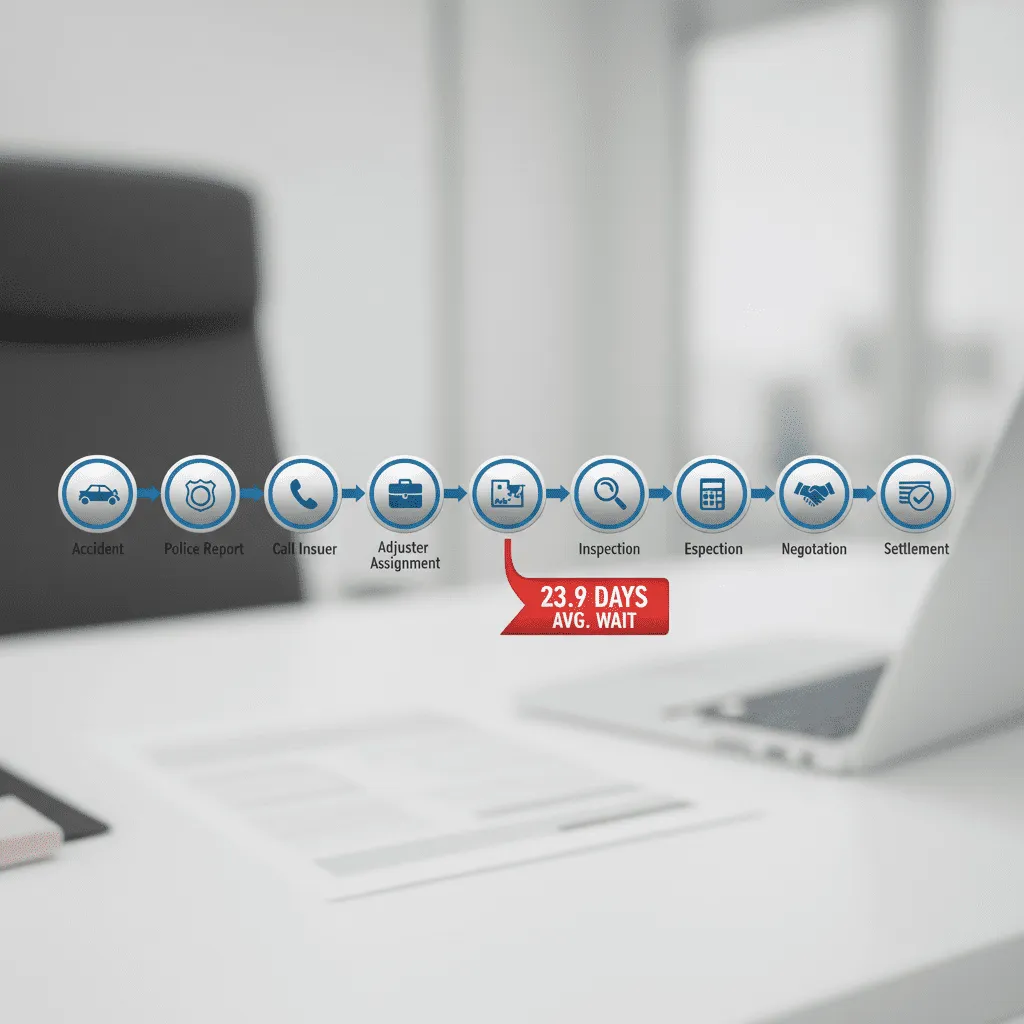
Be prepared for delays. According to the J.D. Power 2024 U.S. Property Claims Satisfaction Study, the average cycle time for property repairs reached 23.9 days in 2024. This is a 6-day increase from previous years. This delay is often used as a pressure tactic—insurers know that desperation leads to accepting lower settlements.
Actual Cash Value (ACV) vs. Replacement Cost
You must understand the math on your estimate.
- Replacement Cost Value (RCV): What it costs to buy the item new today.
- Actual Cash Value (ACV): RCV minus depreciation (wear and tear).
Most checks are cut for ACV initially. The withheld money is called depreciation recoverable. You usually only get this money after you prove you replaced the item. If you don’t understand this, you are leaving money on the table.
Phase 4: Negotiation and Settlement
The first offer is rarely the best offer. In my experience, the initial settlement figure is the “floor,” not the ceiling. It is a test to see if you are desperate or uninformed.
The “Three Estimate” Strategy
Never rely solely on the adjuster’s estimate or their “preferred shop.”
According to the J.D. Power 2024 U.S. Auto Claims Satisfaction Study, auto repair costs rose 26% between 2022 and 2024. Adjusters are incentivized to write estimates that are lower than these rising market rates.
The Strategy: Get three independent estimates from reputable contractors or body shops. If the adjuster’s offer is $5,000 but your three estimates average $8,500, you have strong evidence to demand a “supplement.”

Handling the Lowball Offer
When you receive a lowball settlement offer, do not get angry. Get analytical. Use the “Silence Tactic.” When they quote a low number, stay silent for 10-15 seconds. The awkward silence often forces the adjuster to justify the number or admit there is wiggle room.
If silence doesn’t work, send a formal rejection letter.
“Dear [Adjuster Name],
I am in receipt of your settlement offer dated [Date] in the amount of [Amount]. I am rejecting this offer as it does not accurately reflect the cost to restore my property/health to pre-loss condition.
Attached are three independent estimates from licensed professionals in [Your City], all of which exceed your offer by approximately [Percentage]. Please review these documents and update your valuation to reflect current local market rates.
I look forward to your revised offer.”
When to Call for Backup
Sometimes, despite your best efforts, the insurer acts in bad faith. This might look like “ghosting” you (ignoring calls), delaying payment without cause, or misrepresenting policy language.
The “Bad Faith” Escalation Ladder
- Request a Manager: If an adjuster is unresponsive, call the main claims line and ask for a supervisor.
- File a Department of Insurance Complaint: Every state has a regulator. A formal complaint forces the insurer to respond in writing within a set timeframe. You can find your state regulator via the National Association of Insurance Commissioners (NAIC).
- Hire Representation: If there are serious injuries or the claim is complex (like a total fire loss), a public adjuster or attorney may be necessary.
Digital Warning: While digital apps are convenient, the J.D. Power 2024 U.S. Claims Digital Experience Study found that customer satisfaction drops over 100 points when claimants are forced to switch channels (e.g., from app to phone) to resolve issues. If the app isn’t working, pick up the phone immediately.
Frequently Asked Questions
Should I accept the first check from my adjuster?
Generally, no, unless it is clearly labeled as an “undisputed” partial payment. If the check or accompanying letter states “full and final settlement,” cashing it releases the insurer from future liability. Always clarify if the check is an advance or a settlement.
What happens if I forget to tell the adjuster something?
You can update your claim. Send an email immediately titled “Correction to Statement” or “Addendum to Claim.” Honesty is vital; correcting a mistake is better than letting it look like a lie later.
Can I fire my assigned insurance adjuster?
You cannot “fire” them like an employee, but you can request a reassignment. If the adjuster is rude, unprofessional, or clearly incompetent, contact their supervisor and formally request a new handler for your file.
Is the adjuster allowed to talk to my neighbors?
Yes. Adjusters investigating liability or potential fraud often canvass neighborhoods to verify facts. This is standard procedure, especially in unwitnessed accidents or home burglary claims.
Conclusion
Navigating an insurance claim is a marathon, not a sprint. The system is designed to reward patience and documentation. By treating your adjuster with professional firmness, refusing to be rushed, and backing up every demand with data (and independent estimates), you shift the power dynamic in your favor.
Remember: You paid your premiums for this protection. Don’t feel guilty for negotiating what you are owed. Document everything, stay calm, and keep your “claim journal” close.