
Quotes Made Easy: What to Look For Beyond the Price Tag
Comparing Quotes Made Easy: What to Look For Beyond the Price Tag
In 2024, the average gap between the “cheapest” quote and the “best” value isn’t just money—it’s 23 days of waiting for a repair. I’ve seen it happen time and time again in my years covering personal finance and consumer protection: a homeowner or driver picks the lowest number on the spreadsheet, feels a momentary rush of victory, and then pays for it dearly six months later.
If you are staring at three different estimates right now—whether for a roof replacement, auto insurance, or a software vendor—you might be wondering why the prices vary so wildly. Is the expensive one ripping you off? Is the cheap one cutting corners?
Here is the reality: Price is just one line item. The real story lies in the “value mechanics”—the solvency, the speed, and the scope. In this definitive guide, we will move beyond the bottom line. Using the latest late-2024 and early-2025 industry data, I’ll show you exactly how to compare quotes so you can sign that contract with absolute confidence.

The Price Tag Trap: Why “Lowest Bidder” Often Costs More
There is a psychological pull to the bottom line. It’s measurable and immediate. But in the service industry, the “lowest bidder” is often synonymous with “highest risk.”
When you accept a significantly lower bid, you aren’t just saving money; you are usually accepting a transfer of risk. The contractor or insurer is offloading the risk of delays, material quality, or future repairs onto you.
2024 Scam Alert
The danger isn’t just poor quality; it’s financial loss. According to the BBB Scam Tracker Risk Report (2024), home improvement scams were among the riskiest categories for consumers, with a median loss of $1,800 per victim. Often, these scams begin with a quote that looks “too good to be true.”
I recall a specific case where a neighbor accepted a roofing bid that was $2,000 cheaper than the rest. The contractor didn’t include disposal fees or permits in the quote. By the time the job was done, my neighbor had paid an extra $2,500 in “unforeseen costs” and fines. The cheapest quote became the most expensive one.
The 3 Pillars of a Bulletproof Quote Comparison
To perform a true apples to apples comparison, you need to break down every proposal into three non-negotiable pillars: Scope, Time, and Trust.
1. Scope of Work & Exclusions (The “Fine Print”)
The scope of work discrepancy is the most common reason for price variance. If Quote A is $500 and Quote B is $800, ask yourself: What is Quote B doing that Quote A isn’t?
You need to perform a “gap analysis.” Look for missing line items such as:
- Disposal and Cleanup: Who hauls away the debris?
- Permits and Taxes: Are they included or estimated?
- Material Grades: Is the contractor using generic “builder grade” materials or premium brands?
2. The Time Factor (Speed vs. Cost)
Time is money, but in 2025, time is also sanity. Supply chain issues and labor shortages have made “speed” a premium commodity.
According to the J.D. Power 2024 U.S. Property Claims Satisfaction Study, the average property claim repair cycle has extended to 23.9 days. That is over six days longer than in 2022. If a cheaper insurer or contractor cannot guarantee a timeline, you are paying for that savings with weeks of your life.
— Mark Garrett, Director of Claims Intelligence at J.D. Power (March 2024)
3. Financial Solvency & Trust
Will this company exist to honor the warranty in five years? A contractor solvency check is something most homeowners skip, but it’s vital. A low quote might indicate a company is desperate for cash flow to pay off debts from a previous job (a practice known as “robbing Peter to pay Paul”).
Check their Better Business Bureau rating and ensure they have a physical address, not just a P.O. Box.

Sector Deep Dive: How to Compare Insurance Quotes
Insurance is perhaps the hardest area to compare because you are buying a promise, not a physical product. With auto insurance shopping increasing by 19% year-over-year in Q3 2024, according to the TransUnion 2024 Insurance Trends Report, consumers are aggressively hunting for better rates. Here is how to do it right.
Beyond the Premium: Deductibles and Limits
The premium is what you pay monthly; the deductible is what you pay when disaster strikes. A common trick to lower a quote is to skyrocket the deductible.
Imagine Quote A offers a $100/month premium with a $2,000 deductible. Quote B offers $130/month with a $500 deductible. Quote A saves you $360 a year. But if you have an accident, you are out $1,500 more immediately. It would take over four years of “savings” to cover that one-time loss.
The “Hassle” Metric: Claims Satisfaction Scores
When you are stranded on the side of the highway, you don’t care about the $10 you saved a month. You care about the tow truck arriving.
Trust is the new currency. The J.D. Power 2024 U.S. Auto Insurance Study found that customers with high trust levels (scoring 917/1000) are 90% likely to renew their policy, regardless of price hikes. In contrast, low-trust customers are only 30% likely to renew.
Furthermore, data from the National Association of Insurance Commissioners (NAIC) suggests that claim handling issues accounted for 65.2% of all closed insurance complaints in 2024. When comparing quotes, look up the insurer’s NAIC complaint index. If it’s high, that “cheap” quote comes with a headache.
Comparison Matrix: The “Apples-to-Apples” View
| Feature | Quote A (The “Cheap” Option) | Quote B (The Value Option) |
|---|---|---|
| Monthly Price | $95.00 | $125.00 |
| Deductible | $2,500 | $500 |
| OEM Parts Coverage | No (Aftermarket Only) | Yes |
| Avg. Claim Cycle | 25+ Days | 14 Days |
| Rental Car | Excluded | Included ($50/day) |
Sector Deep Dive: How to Compare Contractor Bids
Home improvement is where the material specifications list becomes critical. Inflation is real; the Thumbtack Home Care Price Index (July 2024) shows the annual cost of home maintenance hit $10,147, a 4.69% increase year-over-year.
Material Grades and “Allowances”
Watch out for the word “allowance” in a quote. This is a placeholder budget the contractor gives you for materials (like tile or fixtures) that haven’t been selected yet. A low-ball quote often includes “builder grade” allowances that won’t cover the quality you actually want, forcing you to pay the difference later.
ROI Analysis: Will This Quote Pay You Back?
Not all renovations are equal. When comparing quotes, consider the Return on Investment (ROI). Are you paying for something that adds value to your home?
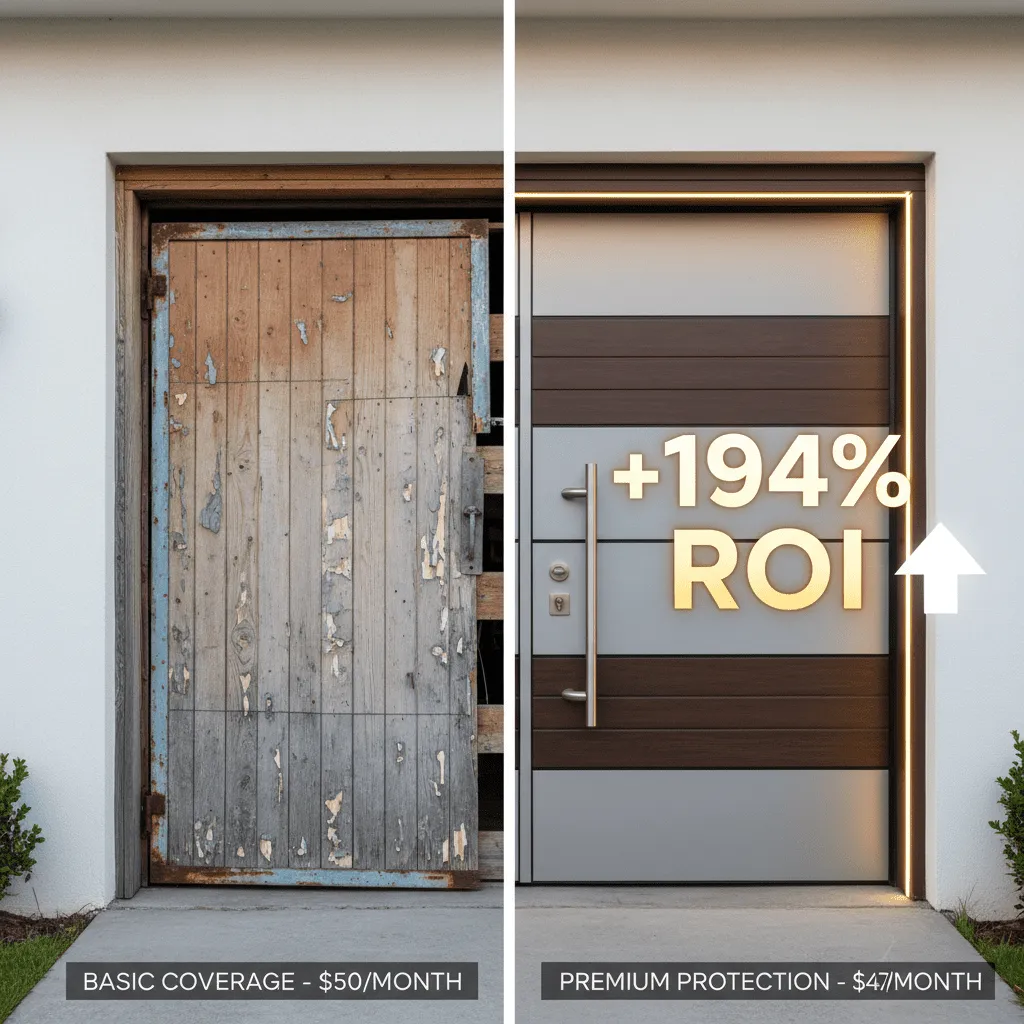
According to the Zonda (Remodeling) 2024 Cost vs. Value Report, the #1 ROI project for 2024 is Garage Door Replacement, recouping a massive 194% of costs. In contrast, an HVAC conversion only recoups about 66%. If you are comparing quotes for a garage door, paying a bit more for a higher-end model (better curb appeal) actually makes more financial sense than going cheap.
— Todd Tomalak, Principal at Zonda Advisory (April 2024)
The “True Cost” Calculator
Use this simple tool to estimate the “Hidden Risk Cost” of a cheaper quote that might be delayed. Input the daily value of the service (e.g., $50/day for a rental car if your car isn’t fixed, or $100/day for hotel if your bathroom isn’t done).
Red Flags: When to Walk Away From a Quote
Sometimes, the best quote is the one you reject. In my experience auditing proposals, these are the immediate deal-breakers:
- The “Today Only” Discount: High-pressure sales tactics are a hallmark of scammers or desperate vendors. A reputable professional knows their price is valid for 30 days.
- Demanding >50% Upfront: For contractors, paying for materials upfront is normal, but demanding the majority of the labor cost before work begins is a major red flag for solvency issues.
- No “Force Majeure” or Delay Clause: If the contract doesn’t specify what happens if they can’t finish on time, walk away.
- Vague Descriptions: If a line item just says “Materials – $5,000” without a breakdown, they are hiding profit margins or planning to use cheap goods.
FAQ: Common Questions About Comparing Quotes
How many quotes should I really get?
For standard jobs (like car insurance or a small repair), three quotes is the industry standard. This gives you a low, a high, and a median. For complex projects (like a home addition or enterprise software), aim for five to see where the outliers are.
Is the lowest bid ever the right choice?
Yes, but only for “commodity” goods where the product is identical regardless of the seller (e.g., buying a specific model of laptop). For services involving labor, skill, or insurance coverage, the lowest bid is rarely the best value.
How do I politely decline a quote?
Be professional and honest. “Thank you for your time. We have decided to go with another vendor who offered a scope of work that better aligned with our current needs.” You do not need to apologize for seeking value.
Conclusion
Comparing quotes is more than just a math problem; it’s a risk assessment. As we move through 2025, the volatility in labor markets and supply chains means that stability and reliability are worth paying for.
Remember the formula: Value = Price + Speed + Reliability.
Don’t just look at the bottom line. Look at the timeline. Look at the exclusions. Look at the trust scores. By doing this extra legwork, you ensure that the price you sign is the price you actually pay—without the hidden costs of stress and delay.
Take the time to verify, compare, and question. Your wallet (and your peace of mind) will thank you.