Your Policy: Key Sections Everyone Should Understand
Unpacking Your Policy: The 4 Key Sections Everyone Must Understand (2025 Guide)
Let’s be honest for a moment. When was the last time you actually read your insurance policy? I don’t mean glancing at the bill to see if the premium went up. I mean actually reading the contract.
If you haven’t, you aren’t alone. In fact, most Americans treat their home and auto insurance policies like Apple Terms of Service agreements—scroll to the bottom, click “accept,” and hope for the best. But unlike a software update, ignoring this document can cost you your life savings.
In my years working in risk analysis, I have seen claims denied not because the insurance company was “evil,” but because the policyholder simply didn’t understand what they bought. They assumed “full coverage” meant “everything is covered.” It never does.
In 2025, with premiums rising and coverage tightening, ignorance is an expensive luxury. This guide unpacks the “D.I.C.E.” framework—Declarations, Insuring Agreement, Conditions, and Exclusions—so you can finally understand the contract protecting your most valuable assets.

The “D.I.C.E.” Framework: How Policies Are Structured
Insurance policies are intimidating. They are dense, legalistic, and often span 50+ pages. However, almost every Property & Casualty (P&C) policy—whether it’s for your car, home, or business—follows a standard structural flow known in the industry as D.I.C.E.
D – Declarations (The Receipt)
I – Insuring Agreement (The Promise)
C – Conditions (The Rules)
E – Exclusions (The Gotchas)
Once you understand this anatomy, the document transforms from a confusing mess into a navigable contract. Let’s break down each section, focusing on the traps that usually catch people off guard.
1. The Declarations Page (“The Dec Page”)
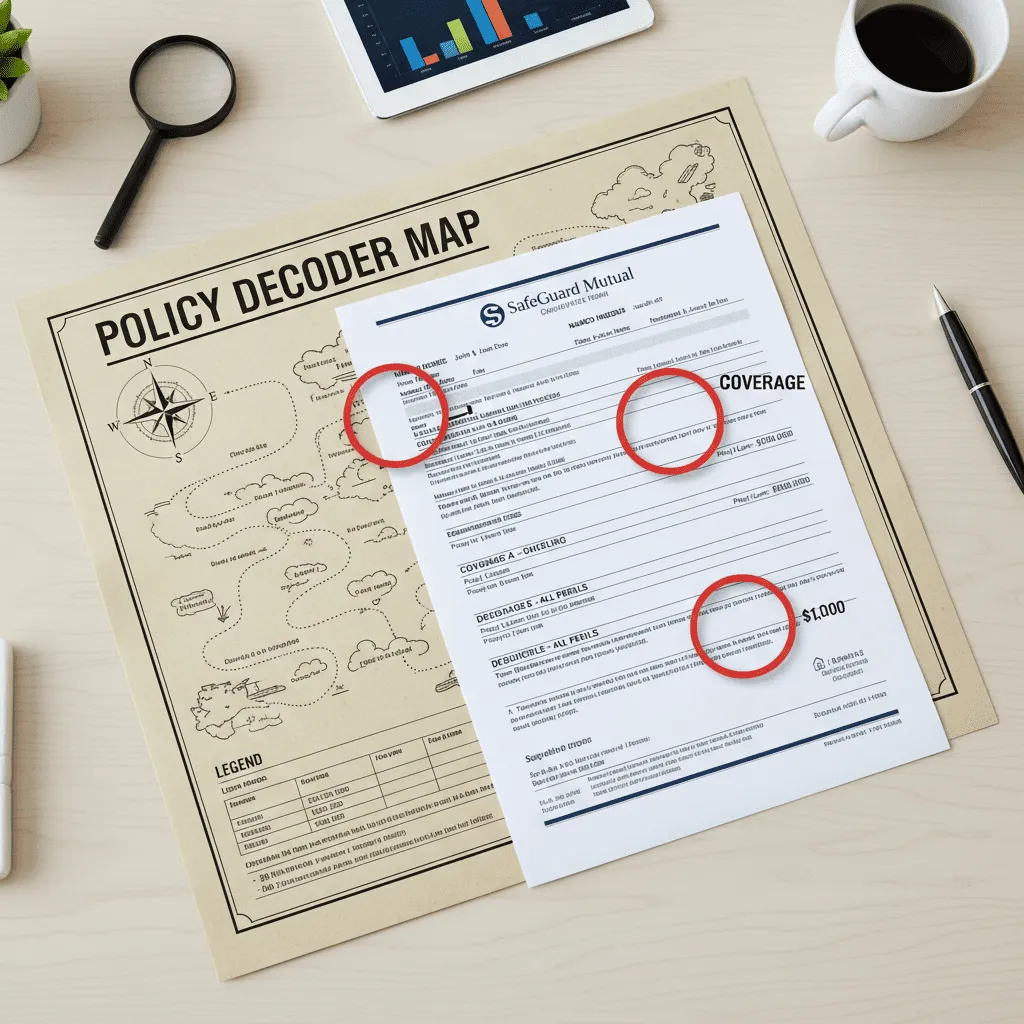
The Declarations page is usually the first page of your policy. Think of this as the “Receipt” or the “Executive Summary.” It customizes the standard contract to you.
While this is the section people look at most often, it is also where the most immediate errors occur. A 2024 analysis by C&S Insurance indicates that rising inflation has left many homeowners underinsured on their Dec pages because they haven’t updated their replacement costs to match current construction prices.
Why It’s the “Receipt” of Your Policy
The Dec Page declares who is insured, what property is covered, the time frame of coverage, and the cost. It separates your policy from your neighbor’s.
Critical Numbers to Check
When you receive your renewal, pull out the Dec Page and verify these three specific areas immediately:
- Policy Limits: This is the maximum amount the insurer will pay. In 2025, checking your “Coverage A” (Dwelling) limit is vital. If your home would cost $500,000 to rebuild today but your Dec Page says $350,000, you are self-insuring the difference.
- Deductibles: This is your “skin in the game.” Watch out for percentage-based deductibles. A $1,000 deductible is standard, but a “2% Hurricane Deductible” on a $500,000 home means you pay the first $10,000 before the insurer pays a dime.
- Policy Period: Claims must occur between the “Effective Date” and “Expiration Date.” I’ve seen claims denied because an incident happened at 11:00 PM the night before a policy renewed.
Common Mistakes
The biggest error I see on Dec Pages is incorrect “Named Insureds.” If you own a home with a partner, but only your name is on the Dec Page, the check for a claim will be made out to you. If you die, your partner may face a legal nightmare trying to collect benefits. Always ensure everyone with an ownership interest is listed.
2. The Insuring Agreement (The Promise)
If the Dec Page is the summary, the Insuring Agreement is the core engine of the contract. This is the sentence (or paragraph) where the insurance company actually promises to pay you.
This section usually begins with: “We will pay for direct physical loss to the property described…” But the devil is in the details of how they pay.
Named Perils vs. Open Perils (All-Risk)
This is the single most important concept in property insurance. You must know which type of agreement you have.
- Named Perils: The policy lists specific events (perils) that are covered, such as fire, lightning, or theft. If a meteorite hits your house and “falling objects” isn’t on the list, you have no coverage.
- Open Perils (Often called All-Risk): This covers everything unless it is specifically excluded. This provides broader protection.
Most modern homeowners policies (HO-3 forms) are a hybrid: Open Perils for the structure, but Named Perils for your personal belongings. It is crucial to understand that “All-Risk” does not literally mean all risks. It effectively means “All risks except the ones we list in the Exclusions section.”
3. The Exclusions (The “Gotchas”)
In my opinion, this is the section you should read first. The Exclusions section takes away coverage that the Insuring Agreement appeared to give.
Given the climate volatility we are seeing, understanding exclusions is more critical than ever. According to the Swiss Re Sigma Report regarding 2024 data, global insured losses from natural catastrophes hit $137 billion, yet 57% of economic losses remained uninsured. This gap exists largely because of exclusions.
The “Anti-Concurrent Causation” Clause (ACC)
This is the scariest clause in your policy, and very few agents explain it. The ACC clause essentially states that if two events happen at the same time to cause damage—one covered (like wind) and one excluded (like flood)—the insurer can deny the entire claim.
The 3 Types of Exclusions
- Excluded Perils: Events that are never covered. Flood, Earth Movement (Earthquake), and War are universal exclusions. You need separate policies for these.
- Excluded Property: Items the policy won’t pay for, such as pets, cars (covered by auto insurance), or business data stored on a home computer.
- Excluded Actions: Intentional acts. If you burn your own house down, or if you neglect a leak for three years until the floor rots, coverage is denied due to “neglect” or “wear and tear.”
New 2024/2025 Trends: Cyber and Wind
Policies are evolving. Andrew N. Mais, NAIC President, has noted that regulatory priorities are shifting to address climate risks. Consequently, many 2025 policies are introducing specific “Cosmetic Damage Exclusions” for roofs (meaning they won’t pay for hail dents if the roof doesn’t leak) and stricter Cyber exclusions, ensuring your home policy doesn’t pay for ransomware attacks on your personal laptop.

4. The Conditions (The Rules of the Game)
You have paid your premium, but you still have duties to fulfill. The Conditions section outlines the “rules of the game.” If you break these rules, the insurer can void the contract.
“Duties After a Loss”
This is the most time-sensitive paragraph in your policy. It dictates what you must do immediately after an accident. Usually, this includes:
- Giving prompt notice (filing the claim).
- Protecting the property from further damage (e.g., nailing a tarp over a hole in the roof).
- Cooperating with the investigation.
This is where satisfaction often plummets. According to the J.D. Power 2024 Property Claims Satisfaction Study, customer satisfaction has dropped to a seven-year low (869 on a 1,000-point scale), largely due to longer cycle times. The study notes that the average claims cycle time reached 23.9 days in 2024.
— Mark Garrett, Director of Claims Intelligence at J.D. Power
If you fail to “protect the property from further damage”—for example, letting rain pour into a broken window for a week—the insurer can cite the Conditions section to deny the water damage claim, even if the broken window was a covered event.
Subrogation: The Right to Sue
Subrogation sounds complex, but it’s simple: It prevents you from getting paid twice. If your neighbor burns down your fence, your insurance pays you. But by accepting that money, you transfer your right to sue the neighbor to your insurance company. They will sue the neighbor to get their money back. You cannot collect from your insurer and sue the neighbor for the same fence.
Definitions & Endorsements (The Fine Print)
Finally, we reach the sections that modify everything we just read.
Why “Definitions” Change Everything
In everyday language, “flood” and “water backup” might sound like the same thing—water in your house. In insurance definitions, they are opposites.
- Flood: Water rising from the ground up (overflow of a river). usually excluded.
- Water Backup: Water coming back through pipes or drains. usually requires an endorsement (add-on).
Always check the Definitions section to see how terms like “Occupying,” “Insured Location,” and “Business” are defined.
How Endorsements Modify the Contract
Endorsements (or Riders) override the standard text. They can add coverage (like scheduling a diamond ring) or remove it.
In the current economic climate, the Inflation Guard Endorsement is vital. With construction costs soaring, this endorsement automatically increases your coverage limits annually to keep pace with inflation. Without it, you might find yourself with 2020 coverage limits in a 2025 economy.

FAQ: Common Policy Confusions Solved
What are the 4 main sections of an insurance policy?
Almost all Property & Casualty policies follow the D.I.C.E. framework: Declarations (the summary), Insuring Agreement (the promise to pay), Conditions (your duties), and Exclusions (what is not covered).
Where do I find my policy limits?
Your policy limits are located on the Declarations Page (Dec Page), which is typically the first page of your policy packet. It will list limits for Coverage A (Dwelling), Coverage B (Other Structures), Coverage C (Personal Property), and Liability.
What happens if I don’t read my insurance policy?
Failing to read your policy puts you at risk of the “protection gap.” You may assume you have coverage for events like floods or sewage backup, only to find out after a disaster that they are excluded. Additionally, failing to follow the “Conditions” regarding reporting timelines can lead to a valid claim being denied.
Does the declarations page show exclusions?
Generally, no. The Declarations page shows your limits, deductibles, and endorsements. Specific exclusions (like mold, earth movement, or wear and tear) are listed deep in the policy document under the section titled “Exclusions” or “Losses Not Insured.”
Conclusion: The Policy is a Contract, Not a Suggestion
I know this might seem overwhelming. Insurance language is dense by design—it has to be legally precise to stand up in court. But you don’t need a law degree to protect yourself; you just need to know where to look.
The “D.I.C.E.” framework gives you the map. Your Declarations page tells you what you have. The Insuring Agreement tells you when it applies. The Conditions tell you how to act. And the Exclusions tell you the hard truth about what you must face alone.
As we navigate 2025, with homeowners insurers reporting seven consecutive years of underwriting losses and premiums rising to match, being passive is no longer an option. You cannot afford to pay thousands of dollars a year for a mystery.
Here is your immediate action plan:
- Pull out your Declarations Page right now.
- Check your Named Insureds—is everyone listed?
- Check your Deductible—can you afford to pay that amount in cash tomorrow?
- Scan your Exclusions for “Water” and “Ordinance or Law.”
Knowledge is the only coverage that doesn’t cost a premium. Make sure you have it.